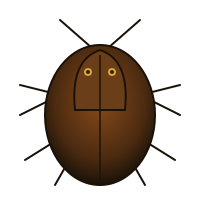
A satirical party with no candidates. No registered office. No manifesto beyond a meme — a joke born from a Chief Justice comparing student protesters to insects. Within eight days it had more Instagram followers than any political party in India. That is when the government reached for its law.
Section 69A of the Information Technology Act is the provision that lets the government order platforms to block content in the name of national security. It requires no court order. No public hearing. No disclosed reason. It was designed for insurgent propaganda and foreign threats. The government used it on a meme party run by a Boston University student with a roach logo and a sense of humour about power.
Then police were deployed to the student's parents' house. Not as suspects — as people who need round-the-clock protection because their son started a joke online. That is not the government being strong. That is the government showing what it is afraid of. When you need Section 69A and uniformed officers at a family home in Chhatrapati Sambhajinagar to neutralise a satirical Instagram account, you have told the public exactly how threatened you feel — and by what.
The Numbers That Scared the Government
The Cockroach Janta Party's Instagram account crossed 20 million followers in under eight days. BJP's Instagram following at the time of the block stood at approximately 9 million — less than half. CJP became, for a brief period, the most-followed political account on Instagram in India, representing a party with no elections, no candidates, no party office, and no budget. (Deccan Herald; Outlook India)
When the government moved to block CJP accounts and the primary website, the backup handle @Cockroachisback went live on X. It gained 21,000 followers within one hour. (Al Jazeera) The block did not reduce interest. It created a news event that sent people searching, joining, and sharing. This is the Streisand Effect, operating in real time.
The numbers are the story the government did not want told. 20 million people joining a satirical movement in eight days is a data point about public sentiment — about unemployment, about NEET paper leaks, about a generation that feels the system was built for someone else. The block did not erase that data point. It underlined it.
The Escalation: From Meme to "National Security"
The sequence from joke to crackdown took nine days.
- May 15, 2026: Chief Justice of India Surya Kant, during a Supreme Court hearing on fake law degrees, referred to student protesters as "cockroaches." The remark circulated nationally within hours. (CBS News)
- May 16, 2026: Abhijeet Dipke, a Boston University student and former AAP communications strategist, registered the Cockroach Janta Party name and launched it online. (Wikipedia; Al Jazeera)
- May 21, 2026: MeitY ordered X to withhold the @cockroachjantaparty account in India under Section 69A, citing an Intelligence Bureau report that alleged the account threatened India's "sovereignty" and "national security." (Business Today; OneWorld News)
- May 22, 2026: Instagram restricted CJP's account.
- May 23, 2026: The cockroachjantaparty.org website was blocked in India via DNS. Dipke told Al Jazeera: "The government has taken down our iconic website — 10 Lakh cockroaches had signed up on our website as members." The community site at cockroachjantaparty.buzz was not blocked. (Business Today; Deccan Herald)
- May 24, 2026: Police deployed round-the-clock security at Dipke's family residence in Chhatrapati Sambhajinagar. (The Week)
Nine days. A Chief Justice's offhand remark, a student's satire, 20 million followers, a national security order, a DNS block, and police at a family home. No other political force in India generated this much government response with this few resources in this short a time.
Vir Das Named It. The World Agreed.
Bollywood comedian Vir Das was among the first prominent voices to name what had happened. He called the block "an utterly dumb move" and said it had given CJP "the full Streisand Effect." (News9Live; CIOL) He was not alone.
Congress MP Shashi Tharoor described the crackdown as "disastrous and deeply unwise," calling CJP a "revelation" of the frustration felt by Indian youth over unemployment and governance failures. (The Print)
Amnesty International described what happened as "online censorship," noting how quickly political humour becomes a government target once it reaches mass scale. (Kashmir Media Service)
The Internet Freedom Foundation called the block a "blatant misuse of State power" and an "arbitrary and disproportionate attempt to stifle freedom of speech and expression." (Internet Freedom Foundation)
International outlets covering the story included Al Jazeera, CBS News, NBC News, and CNN. A satirical Indian party with a roach logo had become a global press event — because of the block, not despite it. The suppression was the story.
What the Government Actually Proved
The Intelligence Bureau called CJP a national security threat. Let that sit for a moment. A party with no manifesto beyond a meme, no registered office, no candidates, no budget, and a founder studying public relations at Boston University — classified as a threat to the sovereignty of India.
By reaching for Section 69A, the government confirmed everything the cockroach metaphor was saying. The roach represents something that cannot be exterminated by conventional means — something that multiplies in the dark, that survives because it adapts, that is everywhere the powerful would rather not look. The block did not contradict that metaphor. It illustrated it.
Police were deployed to Dipke's family residence in Chhatrapati Sambhajinagar for security — round-the-clock, as of May 24, 2026. Not because the family had done anything. Because a student started a movement so large that someone sent him death threats and the state had to respond. (The Week)
The government's actions have a collective meaning: they are afraid of satire. They are afraid of 20 million people laughing at the same joke. They are afraid of a generation that has noticed the gap between what it was promised and what it received, and decided to name that gap with a roach on a flag. That fear, made visible through a Section 69A order and a police deployment at a family home, is the most honest thing the government has said about CJP.
The Cockroach Survives
cockroachjantaparty.buzz — the .buzz domain — was not blocked. It is the site you are reading right now. The blog, the manifesto, the leaders page, the join page: all live. The government blocked cockroachjantaparty.org. They did not reach this domain.
Membership is open. The movement continues. The block made international news. The backup account gained 21,000 followers in an hour. The IFF and Amnesty International issued formal condemnations. Shashi Tharoor called it unwise. Vir Das called it dumb. The world watched.
A cockroach does not just survive. It multiplies when you try to kill it. The government knew that when they chose the Section 69A route — or they should have. The badge is how a young Indian says they were here, they noticed, and they are still here.
No price shown here — the badge is on the join page.
Buy the Digital Badge →