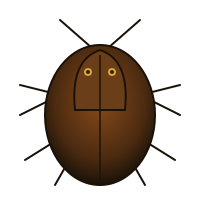
One of the loudest sub-arguments on Reddit's r/india threads about CJP, in the days after the party was founded, has been over a single question: "is this actually serious, or is it the next Loony Party?" The question is fair. The cockroach branding is funny, the tagline ends with the word "Lazy", and the founder's own X handle has the air of an extremely committed shitpost. This piece is a careful explanation of where the line sits — what is satire and meant to be read as such, and what is dead serious. The conclusion, in advance, is that CJP is doing both at once on purpose.
Why this question even exists
Two reasons. The first is the trigger. CJP's founding was triggered by CJI Surya Kant's "cockroaches" remark on 15 May 2026 — a remark that itself became a meme within hours. Founding a party named "Cockroach Janta Party" the next morning is, on its face, a joke. The cockroach is a reclamation, and reclamations are funny by nature.
The second is the surface. Everything you see on the website's home page when you visit for the first time is meme-shaped: the logo is a stylised cockroach, the slogan is "Main Bhi Cockroach", the tagline is "Secular. Socialist. Democratic. Lazy." (a deliberate four-letter inversion of the constitutional preamble's "Secular. Socialist. Democratic. Republic."), the merch is a T-shirt that says "we don't squash ideas", and the membership card has an antennae motif. If you read only this surface, "satirical party" is the natural conclusion.
The natural conclusion is half-right. The other half is in the layer underneath.
The satirical surface — slogan, tagline, logo
The satirical layer is real and acknowledged. CJP is not pretending the cockroach name is a coincidence; the founder's note explicitly says "the label is the membership card". There are four set-pieces in the satirical surface and each is doing visible work.
- The name. "Cockroach Janta Party" turns an insult into a banner. It is the same move as queer reclamations of "queer" or Dalit reclamations of "Dalit" — using the slur as the badge.
- The slogan. "Main Bhi Cockroach" — "I too am a cockroach" — generalises the CJI's remark into a national self-identification. It is funny because it accepts the insult, which is the move the CJI presumably did not expect.
- The tagline. "Secular. Socialist. Democratic. Lazy." replaces "Republic" with "Lazy". The Indian preamble is being gently teased here — but the teasing is doing a precise argumentative job, covered in our tagline explainer.
- The merch. The "we don't squash ideas" tee, the antennae mug, the "Main Bhi Cockroach" badge. The shop is intentionally meme-friendly because the merch is a recruitment funnel.
The serious core — manifesto, members, MPs
Beneath the surface, almost everything is straight-faced and very deliberate.
- The manifesto. The 5-point manifesto is a serious procedural-reform document. No Rajya Sabha seats for retiring CJIs. UAPA-grade accountability for the CEC over vote-deletion episodes. 55% women's reservation. Time-bound investigations into vote-deletion complaints. A panchayat-level contesting strategy paired with a political-literacy programme. None of those five planks is a joke; the long version is in CJP Manifesto Explained.
- The members. More than one lakh sign-ups in 72 hours, all through the free join page, all tied to the manifesto. People who sign up are joining the document, not the joke.
- The MP endorsements. Mahua Moitra and Kirti Azad are sitting TMC MPs with parliamentary records. Their honorary CJP memberships are not jokes.
- The pledges. The no-sponsors pledge and the refusal-to-merge stance are written in the kind of precise language party constitutions usually are. They are designed to bind future behaviour.
- The legal posture. CJP is not yet a registered party, but its public communications around panchayat-first contesting and eventual ECI filing are deadly serious.
Satire as recruitment funnel
The structural point is that the satire is on the outside because that is what makes the door swing open. People who would never click a serious manifesto link will click on a cockroach. People who would never read a Section 29A explainer will retweet "Main Bhi Cockroach". Once they are through the door, they meet the manifesto, the leaders, the no-sponsors pledge, the panchayat-first plan. The satire does not replace the substance; it carries people to it.
This is a deliberate strategy. The founder, who has watched what happens when reform messages are presented in the same earnest, slightly-shrill register that loses every Twitter thread, has chosen the opposite register. CJP's outward voice is closer to other satirical political projects in India — the Wadakkanchery Loktantrik Mukti Morcha being the closest cousin — but its underlying ambition is closer to the early Lok Satta Andolan. The combination is what is genuinely new.
The risk of being read as 'just a joke' — and CJP's reply
The strategy has a real risk. If you spend long enough wearing a cockroach costume, people may forget you have a manifesto on. Some opponents are already trying to take advantage of this — framing CJP exclusively as "a satirical reaction to the CJI's remark" so that the substance below the surface is never engaged with on its own terms. The X-handle's first week shows several rounds of this back-and-forth.
CJP's reply is a discipline: every meme tweet must be followable by a manifesto link, and every press interaction must end on a serious demand. The "Main Bhi Cockroach" slogan is paired in nearly every social post with one of the five manifesto planks. The pattern is "joke + ask" — funny on the way in, concrete on the way out. As long as that discipline holds, the satire stays a doorway and not a costume.
If you came here trying to decide whether to take CJP seriously: the right answer is "yes, but enjoy yourself on the way". The branding is funny. The argument isn't. Read the manifesto first; the joke makes more sense after the document does.