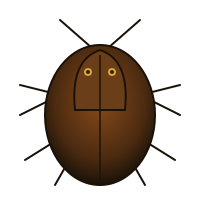
Main Bhi Cockroach — written in Devanagari as मैं भी कॉकरोच — translates literally as "I too am a cockroach." It is the official slogan of the Cockroach Janta Party, and over a three-day stretch in May 2026 it became the most-shared political phrase on Indian social media since "Acche Din". Here is what it means, where it came from, and why a single Hindi-English line shifted a generation.
The literal translation
Strip it to its parts. Main means "I". Bhi means "also" or "too". Cockroach is, well, cockroach — borrowed straight from English, as Indian street Hindi often does. Read together: "I too am a cockroach." The grammatical structure is identical to a hundred other Indian protest phrases — Main Bhi Anna, Hum Bhi Bharat, Main Bhi Chowkidar — but the word at the end is the joke, and the joke is the politics.
Where it comes from
On 15 May 2026, during a Supreme Court hearing on fake law degrees, Chief Justice of India Surya Kant used the word "cockroaches" to describe certain unemployed young people:
"There are youngsters like cockroaches, who don't get any employment and don't have a place in a profession. Some of them become media, some become RTI activists, and they start attacking everyone."
— CJI Surya Kant, 15 May 2026
The CJI clarified the next day that he had meant applicants with fake law degrees, not unemployed youth at large. The clarification did not catch up. The clip did. For the full courtroom context and the next-day walk-back, see our breakdown of the remark.
Why the slogan works
"Main Bhi Cockroach" is a textbook example of reclaiming a slur. The CJI used "cockroach" to demean a category of people; the slogan accepts the label and detonates it. It is short, it is bilingual, it is impossible to mistype, and it makes the speaker the one in on the joke. A few reasons it travelled so fast:
- It demands no permission. You don't need party membership, a degree, or a verified blue tick to declare yourself a cockroach.
- It fits in a username, a bio, a placard, a t-shirt. One of the first official tees launched within 24 hours.
- It is Hindi-English code-switch. Equally legible in Lucknow, Bengaluru and a Boston dorm room.
- It carries a class signal. "Cockroach" is what someone with a profession calls someone without one. The slogan flips that gravity.
From a tweet to a movement, in 72 hours
On the morning of 16 May, a thirty-year-old PR student at Boston University, Abhijeet Dipke, posted a logo and a sign-up form with the line "Main Bhi Cockroach" across the masthead. Within 48 hours, the hashtag was trending non-stop. Within 72, the Cockroach Janta Party had over one lakh registered members. We trace the curve in the viral anatomy.
What it is not
"Main Bhi Cockroach" is not an insult to the judiciary, and CJP has been careful about that. It is not a call to merge with any existing party. It is not aimed at a single state government, a single religion, or a single caste. It is also not — yet — a campaign slogan in a contested election, because CJP is not registered with the Election Commission of India and has explicitly said it will not contest the next general election. For the political logic of that abstention, see our CJP-vs-AAP comparison.
Variants you'll see in the wild
The slogan has already spawned a small family of remixes. The most common:
- Main Bhi Cockroach. Tu Bhi Cockroach. — the call-and-response version, used at meetups.
- Cockroach Hoon, Vote Doonga. — "I'm a cockroach, and I'm going to vote" — the voter-registration push.
- Cockroach Janta, Cockroach Sansad. — used to demand more youth representation in Parliament, riffing on the manifesto's 55% women's reservation demand.
The bigger picture
India has a long history of political slogans that started as insults and ended as identities — from "Garibi Hatao" to "Chowkidar" to "Tukde Tukde". "Main Bhi Cockroach" sits in that lineage, but with one twist: it was coined not by a politician but by a generation, and it travelled not through a podium but through a phone. Whether it endures depends on whether the movement behind it can turn a t-shirt into a turnout number. CJP itself has said that is the goal.
If the slogan resonates, the next step is to sign up, read the 5-point manifesto, or wear the line on a Main Bhi Cockroach tee. The card is free. The cockroach is yours.