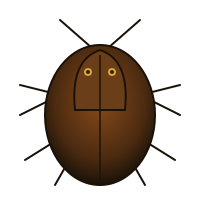
There is a particular kind of compliment that only arrives after you've already won. It looks like an attack, it operates as a counter-movement, and it proves — by its very existence — that the original thing landed with enough force to require a rebuttal. The Oggy Janata Party is that kind of compliment for CJP. It appeared on May 22-23, 2026, the same week the government was busy blocking CJP's website and withholding its X account. The cockroach was being chased by the state from one direction and by a cartoon cat from the other. Neither has caught it yet.
What Is Oggy Janata Party? The Cartoon Logic Behind the Name
The name is the argument. Oggy and the Cockroaches is a French animated series — well-known to Indian Gen Z from its Cartoon Network run — in which Oggy, a portly blue cat, spends every episode trying and failing to evict three cockroaches from his house. The cockroaches always win. Whoever named the Oggy Janata Party picked that cartoon deliberately: if the Cockroach Janta Party is the cockroach, then OJP is casting itself as Oggy. The choice backfires immediately as metaphor, because in the show, Oggy never wins. The cockroaches survive everything the cat throws at them. That is probably not the symbolism OJP's founders intended, but it is the symbolism they got.
OJP launched on May 22-23, 2026, surfacing on Instagram (at @oggy.janata.partyy) and on its own website at oggyjanataparty.com. Within days, it had gathered approximately 9,000 followers on Instagram, according to Republic World, which covered the movement's emergence as an "online satire war." Sunday Guardian and Open The Magazine also ran pieces contextualising OJP as a viral counter-phenomenon to CJP's explosive growth. The press attention was real — though it was considerably thinner than the international coverage CJP had attracted from CNN, NBC News, and Al Jazeera in the same week.
When and How OJP Launched — The Timeline
Timing matters here. OJP did not emerge in a vacuum. It appeared on May 22-23, 2026 — the same week that the Ministry of Electronics and Information Technology ordered CJP's X account withheld under Section 69A of the Information Technology Act, and the same week that cockroachjantaparty.org was blocked in India. The full sequence of those events is documented in our CJP crackdown timeline. OJP arrived, in other words, at the precise moment when the government was already doing the work of suppressing CJP. Whether that timing was deliberate coordination or opportunistic counter-programming is something OJP's anonymous founders have not clarified.
What the timeline shows clearly: OJP's Instagram (@oggy.janata.partyy) crossed approximately 10,600 followers, per Republic World's reporting. The movement also launched a website — oggyjanataparty.com — and began circulating content alleging that Abhijeet Dipke's political history made CJP a partisan project rather than an independent satirical movement. For context: CJP's Instagram had amassed 21.9 million followers before it was hacked on May 23. The scale comparison is not close.
The Core Charge: Did Abhijeet Dipke Work With AAP?
OJP's central allegation is that Dipke had Aam Aadmi Party connections — circulating LinkedIn screenshots they claim show campaign work between 2020 and 2023, including what they attribute to him as the statement: "No distance will ever weaken my commitment to AAP." This is the part that requires careful labelling.
Here is what is confirmed: Dipke himself, in a May 20, 2026 interview, confirmed that he had worked with the Aam Aadmi Party and that he was inspired by its health and education policies. This is his own public statement, reported by The Federal. It is a fact. CJP's own CJP vs AAP explainer addresses this history directly: Dipke's AAP volunteer history runs from 2020 to 2023 and is not a secret.
What OJP adds — the allegation that CJP is therefore an "AAP proxy operation" — is OJP's own inference, not an established fact. That inference is disputed by CJP's open-join structure (anyone can join, regardless of political background), by the movement's stated non-alignment, and by Dipke's own founder's note, which explicitly says "not the BJP, not Congress, not AAP." WION and DNA India both reported on OJP's stated objectives without endorsing its conclusions. The distinction between Dipke's confirmed AAP volunteering past and the proxy-operation allegation is meaningful, and this article treats it as such. For the full founder profile, see the CJP founder page.
OJP's Six-Point Manifesto — What They Actually Want
OJP is not merely a protest against CJP — it has its own stated agenda, covered by both Sunday Guardian and DNA India. Its six-point manifesto focuses on animal welfare: free stray animal healthcare, strengthened anti-cruelty laws, shelter expansion, adoption awareness campaigns, municipal accountability for stray management, and veterinary access in rural areas. These are, on their face, reasonable policy positions. They are also completely unrelated to CJP's agenda.
CJP's five-point manifesto covers judicial independence (no Rajya Sabha seat for retiring CJIs), electoral accountability (UAPA-level consequences for the Chief Election Commissioner over vote deletions), gender representation (55% women's reservation), time-bound vote-deletion investigations, and a panchayat-first electoral strategy. OJP's manifesto has no substantive overlap with any of those five planks. They are not policy rivals in any meaningful sense — they are meta-rivals. OJP is a satire of a satire, and its manifesto's distance from CJP's agenda actually illustrates the point rather than undermining it. You cannot credibly claim to be countering a movement's politics when your counter-platform has nothing to say about those politics. What OJP is really countering is CJP's cultural presence — which is a different, and in some ways more interesting, kind of confrontation.
Update, 24 May 2026: OJP subsequently added a further demand to its online manifesto — the resignation of Education Minister Dharmendra Pradhan over the NEET 2026 paper leak. (Sunday Guardian Live reported on OJP's stated objectives and their overlap with CJP's NEET campaign.) This demand is identical to CJP's own NEET accountability campaign, which generated over 6 lakh petition signatures before the government moved to block CJP's platforms. OJP's Instagram had approximately 10,600 followers at the time; CJP's petition had already crossed 6 lakh signatories before the crackdown began. The policy overlap does not change the scale gap — but it does suggest that whatever OJP's original intent, its manifesto has begun drifting toward the same issues CJP was blocked for raising.
CJP's Position: Satire of Satire Is Still Satire
(This section reflects CJP's editorial perspective, clearly labelled as such.)
CJP was built on a specific kind of non-partisanship — not the performative kind that claims no politics while quietly picking sides, but the structural kind. The movement's origin is the CJI's "cockroach" remark directed at India's youth in a courtroom in May 2026. That grievance did not belong to AAP voters or BJP voters or Congress voters. It belonged to anyone young enough to have been insulted by it. CJP's one-lakh-in-72-hours growth happened because the join door was open to everyone — and it remains open. The 56,000+ people who currently hold digital CJP badges are not screened for political affiliation, because that would defeat the entire point.
The AAP-connection allegation — even if Dipke's volunteer history is taken at full face value — does not change that structure. A movement is not equivalent to its founder's past volunteering history, any more than every AAP voter is secretly running a CJP operation. The question is not what Dipke did before 2023. The question is what CJP's membership looks like in 2026 — and it looks like a genuinely broad, cross-partisan, leaderless swarm. OJP's existence, ironically, proves this: if CJP were an AAP front, OJP would be attacking AAP policy, not CJP's mascot choices.
The cockroach survives everything. Including cats. For more on how CJP differs from each of the major parties, see BJP vs CJP, Congress vs CJP, and CJP vs AAP.
Who's Winning the Satire War?
The scale comparison is unambiguous. CJP had 21.9 million Instagram followers before its account was hacked on May 23, 2026 — a number that took roughly one week to accumulate. OJP had approximately 10,600 when this page was last updated (May 24, 2026). The cat arrived at the house after the cockroaches had already redecorated.
The press coverage gap is similarly wide. CNN covered CJP as a global Gen Z story. NBC News traced the movement's viral anatomy. Al Jazeera reported the government crackdown as an international press freedom incident. OJP received coverage from Republic World, Sunday Guardian, DNA India, and WION — solid Indian digital media, but not the same tier of international attention. More pointedly: the Indian government blocked CJP's website. It did not block OJP's. Governments do not bother blocking things that aren't winning.
The meta-point is the real answer to who's winning. When a movement is large enough to spawn counter-movements, parody accounts, counter-parody accounts, and entire competing organisational structures using the same meme vocabulary — that movement has already won the culture war. OJP's existence is not an indictment of CJP. It is proof that CJP landed. The cockroach that is big enough to need its own Oggy is doing very well, thank you.
The cat showed up. That means the cockroach is winning.
CNN, NBC News, and Al Jazeera are covering this movement. The government blocked the website. Over 56,000 people already have the digital badge.
Get the digital badge →