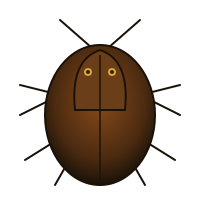
India has had satirical political parties for a long time. Most of them are filed under "amusing footnote" in the bigger story of Indian electoral politics. The Cockroach Janta Party is, at first glance, another entry on that list. Look closer and a few things are different: the scale, the speed, the willingness of sitting MPs to publicly accept its iconography. This piece is a short, fair survey of the genealogy — and an honest assessment of where CJP sits in it.
The Indian tradition of joke-but-not-just-joke parties
Indian electoral law makes it relatively easy to register a political party, which has produced a long tail of small parties with names that are either highly local, highly idiosyncratic, or both. A subset of these are satirical — meant either as protest, performance art, or commentary on the dominant parties of their day.
Three rough categories:
- Performance-art parties. Founded by artists or theatre practitioners. Usually never seriously contest; the existence is the statement.
- Protest-front parties. Born of a specific grievance — a court ruling, a policy, a public scandal. Often dissolve once the trigger fades.
- Hyper-local satire parties. Long, often improbable names. Sometimes a one-candidate operation in a single constituency.
The Surrealist Party
The Surrealist Party emerged from art-and-theatre circles as a satirical commentary on the rigidities of Indian electoral politics. Its existence was a piece of performance. It did not pretend to be a serious contender, and that was the point.
Bharath Madhya Pradesh Loktantrik Bahujan Party
A small party operating in Madhya Pradesh whose name itself reads like a commentary on the proliferation of "Bahujan" / "Loktantrik" / "Bharath" titles in Indian political nomenclature. Whether the satire is intentional is itself debated. In Indian politics, that ambiguity is almost always part of the joke.
Ad-hoc protest fronts
Every few years, an issue — a court verdict, a price hike, a high-profile scandal — produces an ad-hoc protest front with a half-serious party name. These come and go. They rarely outlive the news cycle that produced them.
What makes CJP different
CJP shares DNA with all three categories above. But four things separate it from its ancestors:
1. Scale, very fast
The Surrealist Party and most ad-hoc protest fronts have measured their membership in hundreds, sometimes a few thousand. CJP crossed 1 lakh registered members in 72 hours. Our explainer on the 72-hour ramp walks through how that happened. The relevant fact here is that scale changes category: a satirical party with a hundred thousand members is no longer purely satirical, whether it wants to be or not.
2. Real MPs publicly accepting cards
Most satirical Indian parties have struggled to get any sitting MP to publicly associate. Mahua Moitra and Kirti Azad, both TMC MPs, accepted honorary CJP cards within days of founding. That converts the satire into a media-political object with mainstream legitimacy.
3. A coherent manifesto
The Surrealist Party did not have a 5-point plan you could argue with. CJP's manifesto is short, specific, and policy-shaped — no Rajya Sabha for retiring CJIs, 55% women's reservation, accountability for vote deletion, youth civic infrastructure. These are debatable demands. That is the point. They are real.
4. Internet-native infrastructure
Satirical parties before CJP relied on event-based attention — a play, a protest, a press release. CJP's growth lives in the always-on layer: trending on Twitter/X, viral memes, the Main Bhi Cockroach slogan templated for self-application. That infrastructure didn't exist in the form it does today even a decade ago.
The genealogical line
If you wanted to draw a family tree, CJP descends from three earlier branches:
- India Against Corruption (2011) — the master class in turning a public grievance into national mobilisation, eventually birthing AAP. CJP inherits the mobilisation playbook.
- Stand-up satire television (early 2010s onward) — programmes like The Newshour-adjacent satirical commentary trained a generation of Indians to read political moments as performance.
- The meme-political internet (2019 onwards) — Twitter/X, Instagram reels, WhatsApp templates. CJP runs on this layer the way earlier parties ran on door-to-door work.
The cockroach metaphor would not have produced a hundred-thousand-strong satirical party in 1996. The 2026 information environment makes it possible — and almost predictable — that it would.
Is CJP "really" satirical?
The honest answer is: less and less. The movement began as satirical reclamation — the metaphor used against you, worn proudly. Within a week, it had a manifesto with specific reform demands, a founder who refuses to merge, and two sitting MPs holding cards. That is no longer just satire. It is what one might call satirical scaffolding for an actual public-pressure project.
The satire is the entry door. The manifesto is what's inside the building.
Where the genealogy goes next
Two possible futures for CJP, both consistent with the broader Indian tradition:
- The Anna route. Stay a movement, generate moral pressure, avoid contesting, let others run with the policy demands.
- The AAP route. Register, contest, become a party, pay the costs of formalisation in exchange for legislative leverage.
The founder's note suggests the first route. The 2029 horizon piece works through what the second would look like. CJP's place in the genealogy will be determined by which one it actually takes.
For the cockroach symbolism at the heart of all this, our symbolism explainer has the longer arc.