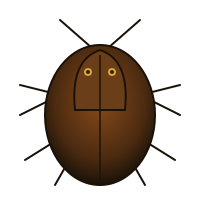
Ask a class of nine-year-olds what would survive a nuclear war and at least one hand will go up with the answer: cockroaches. Ask the same class which animal they like the least and at least one hand will go up with the same answer. That tension — the most-disliked species being the same as the most-respected — is the entire engine of the Cockroach Janta Party's brand.
CJP did not pick the cockroach. The Chief Justice of India did, on 15 May 2026, when he used the word in court. What the party did next was the harder move — accept the animal, then flip the reading.
The pop-biology case for the cockroach
Cockroaches earn their apocalypse reputation honestly. As publicly reported in popular science writing, several traits are repeatedly cited:
- They can survive without their heads for around a week — their nervous system is distributed, not centralised.
- They can go without food for weeks and without water for several days, depending on species and conditions.
- They handle radiation far better than most mammals — not invincible, but resilient enough to outlast many other animals in a catastrophic event.
- They have been on this planet for an estimated 300 million years, predating most mammals, dinosaurs, and certainly the modern political party.
- They breed quickly. A single resilient pair can scale into a colony in weeks.
None of this is in dispute among entomologists. What is interesting for our purposes is how this raw biology gets pressed into political metaphor.
The reframe: resilience is not an insult
When the CJI said "youngsters like cockroaches, who don't get any employment," the implication was visible: scuttling, multiplying, irritating, disposable. CJP's reading is the opposite reading, on the same animal:
You called us cockroaches expecting it to mean small and disposable. We hear it differently. You named the one species that doesn't die. We accept the comparison. We will be the species that doesn't die.
From CJP's founding posts, paraphrased
Same word. Two readings. The fight in 2026 is not about whether we are cockroaches — that part is settled. The fight is about whether being a cockroach is a humiliation or a description of structural resilience in a hostile environment.
What "the hostile environment" actually means
For the cohort CJP claims to speak for, the environment is not metaphorical. Indian youth unemployment in 2026 sits at uncomfortable levels, as publicly reported in PLFS data; educated unemployment is reportedly worse than the overall figure; entry-level salaries in many fields have barely moved in real terms over a decade.
The cockroach metaphor lands on this terrain because, by the time you are 24 and re-applying for the same job for the third year, "survive on less, adapt fast, keep moving" is not a lifestyle aspiration. It is the actual job.
Three biological traits, three political readings
- Distributed nervous system → distributed leadership. CJP has no central command demanding loyalty. The movement spreads by node. If you remove any one cadre, the colony does not stop.
- Long fasting tolerance → fundraising independence. No sponsors, no advertisers, no party donors — that is part of the public pledge. The colony eats less by design.
- Fast reproduction → fast mobilisation. One lakh members in 72 hours is, in colony terms, normal.
Resilience as a political philosophy
The Indian Republic has built itself on resilience metaphors before — the banyan tree, the lotus, the sustained march of swaraj. These metaphors all share a problem: they are aspirational. They flatter the audience. The cockroach refuses to flatter. It says: survival is enough, dignity is what you do with survival.
That is the politics of resilience in its most compressed form. It is not an upward-mobility story. It is an outlast-the-bastards story. And in a political moment where outlasting often matters more than winning, it is a useful frame.
The biology critics will reach for
There is a counter-reading worth taking seriously. Critics of CJP's iconography argue that cockroaches are pests, that they damage food stores, that they carry pathogens. By that reading, accepting the comparison accepts the dirt.
CJP's answer, in the manifesto and across the founding posts, is structural: the cockroach is dirty because the environment is dirty. The species adapts to the kitchen because there is nowhere else to go. The metaphor scales up cleanly to a generation that is "lazy" because the jobs are not there, not because the work ethic is missing. Read more on why the lazy and unemployed now have a party.
Why this brand will outlive the meme cycle
Most viral political symbols decay because they are too narrow. A photoshopped image of a leader. A particular gaffe. The cockroach is different in two ways:
- It is biologically true. The species really does survive things. The metaphor does not require any spin to hold.
- It is culturally invariant. The same cockroach lives in a Mumbai chawl, a Lucknow PG, a Bengaluru flat, and a Boston dorm. The symbol scales to wherever the diaspora is.
CJP's bet is that resilience — the boring, daily, refuse-to-die kind — is the political virtue of the moment. The cockroach is not a clever choice. It is a literal one.
Read the politics of resilience, then act on it. The five-point manifesto turns the metaphor into demands. Join the swarm and the colony grows by one more.